Products › Propellant › Nitrocellulose (Grade C / Type I)
💥 Nitrocellulose (Grade C / Type I)
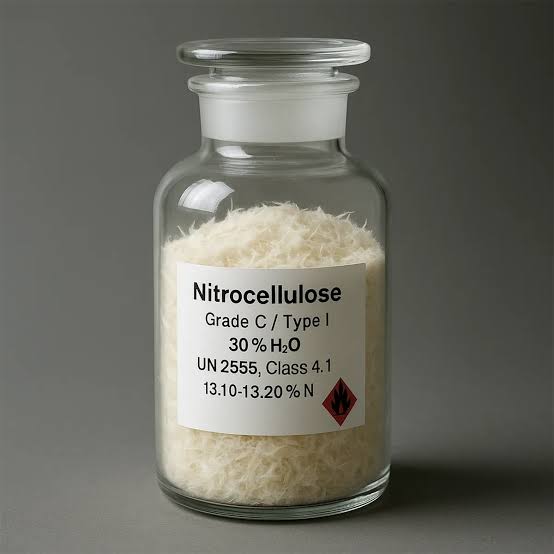
Product Introduction
Nitrocellulose (NC) — also known as guncotton or cellulose nitrate — is the primary energetic material used in virtually all modern smokeless powder propellants. Produced by nitrating purified cellulose (typically wood pulp or cotton linters) with a mixture of nitric and sulphuric acid, nitrocellulose forms the base ingredient of single-base, double-base, and triple-base propellants.
Our military-grade nitrocellulose is supplied at Grade C / Type I specification with a nitrogen content of 13.10–13.20 % N, meeting the requirements for artillery, small-arms, and rocket propellant manufacturing. For safe transport and storage, the material is wetted with a minimum 30 % water content as required under UN 2555, Hazard Class 4.1 (flammable solid, wetted).
Specification Overview
| Chemical name | Cellulose nitrate (nitrocellulose, NC) |
| CAS number | 9004-70-0 |
| Grade | C / Type I (military / propellant grade) |
| Nitrogen content | 13.10 – 13.20 % N |
| Water content (as shipped) | 30 % H2O (min. 25 % per UN regulations) |
| UN number | UN 2555 (nitrocellulose with water) |
| Hazard class | 4.1 — Flammable Solid (wetted) |
| Appearance | White fibrous / cotton-like mass |
| Solubility | Soluble in acetone, ethyl acetate, ether-alcohol mixtures |
| Density (dry) | ~1.66 g/cm³ |
| Ignition temperature | ~170 °C |
Nitrogen Grades (Reference)
Different nitrogen contents give nitrocellulose different properties and applications:
| Nitrogen Content | Grade / Type | Typical Use |
|---|---|---|
| 10.7 – 12.2 % N | Grade A / lacquer type | Lacquers, coatings, films |
| 12.6 – 13.0 % N | Grade B / dynamite type | Dynamite, some double-base propellants |
| 13.10 – 13.20 % N | Grade C / Type I (this product) | Military propellants, small arms, artillery |
| > 13.35 % N | Guncotton | Rocket propellants, high-energy applications |
Applications
- Single-base propellants — primary energetic ingredient in M1 propellant and similar formulations
- Double-base propellants — combined with nitroglycerine for higher-energy small-arms and rocket propellants
- Triple-base propellants — combined with nitroglycerine and nitroguanidine in M30 propellant and similar high-zone artillery propellants
- Rocket motor propellants (composite modified double-base)
- Some plastic-bonded explosives and detonating cord formulations
- Dynamite and industrial explosives (lower-nitrogen grades)
Packaging & Transport
- Supplied in fibreboard drums, lined with polyethylene, wetted with water (minimum 30%)
- Typical drum capacity: 100 kg or 200 kg net (dry basis)
- Must be kept wet during storage and transport — drying out creates a serious explosion hazard
- Shipped under IMDG / IATA / ADR regulations for UN 2555, Class 4.1, PG II